Introduction
Packing for a Hawaii golf trip is different from packing for golf anywhere else — between the trade winds, tropical sun, sudden showers, and airline baggage fees, what you bring (and what you rent) can make or break your rounds. This is the complete, course-tested packing list we recommend for golfing in the islands, plus honest advice on when renting clubs beats lugging your own across the Pacific.
The Short Version
| Bring It | Rent or Buy There |
|---|---|
| Golf shoes (broken in) | Clubs (often smarter — see below) |
| Glove (2–3, humidity eats them) | Push cart (most courses include carts) |
| Reef-safe sunscreen | Rangefinder (if you don't own one) |
| Rain layer (lightweight) | Beach/after-round gear |
| Your favorite balls (a few sleeves) | Extra balls (buy in bulk locally) |
| Hat + polarized sunglasses | Umbrella (courses lend them) |
What to Bring
1. Golf Shoes You Already Trust
Hawaii courses range from manicured resort fairways to muddy municipal layouts after a passing shower, and many have steep, uneven lies. Bring a pair that's already broken in — new shoes plus 18 holes of sidehill lies is a blister recipe. Waterproof or quick-dry models earn their keep on morning rounds with heavy dew.
2. Multiple Gloves
Humidity is the glove killer. Between sweat and passing showers, a glove that would last a month on the mainland can get slick in a single round in Hawaii. Pack at least two or three and rotate them — hang the wet one on your bag between nines. We like the FootJoy WeatherSof for exactly these conditions.
3. Reef-Safe Sunscreen (It's the Law)
Hawaii bans the sale of sunscreens containing oxybenzone and octinoxate to protect the coral reefs — and the resorts take it seriously. Buy reef-safe, SPF 50+ before you fly so you're not paying resort-gift-shop prices. Apply before the first tee and reapply at the turn; the tropical sun is far stronger than the latitude suggests, especially with ocean reflection. A sweat-resistant sport formula like Neutrogena Sport Face SPF 70 holds up best.
4. A Lightweight Rain Layer
Trade-wind showers blow through fast — five minutes of rain, then sunshine. You don't need heavy rain gear; a packable windbreaker or ultralight rain shell handles 95% of Hawaii weather and doubles as a wind layer on exposed courses like Kapalua or the Kohala Coast layouts, where 20–30 mph trades are a normal afternoon.
5. More Balls Than You Think (But Not Your Whole Stash)
Lava rock, ravines, trade winds, and forced carries over gorges eat golf balls — especially on resort courses on the Big Island and Kauai. Bring two or three sleeves of a ball you like, then buy more locally if needed (Costco in Hawaii is a legit golf-ball strategy). Wind-cheater balls with a penetrating flight, like the Titleist Pro V1 or Callaway Chrome Soft, are popular picks for windy island conditions.
6. Hat and Polarized Sunglasses
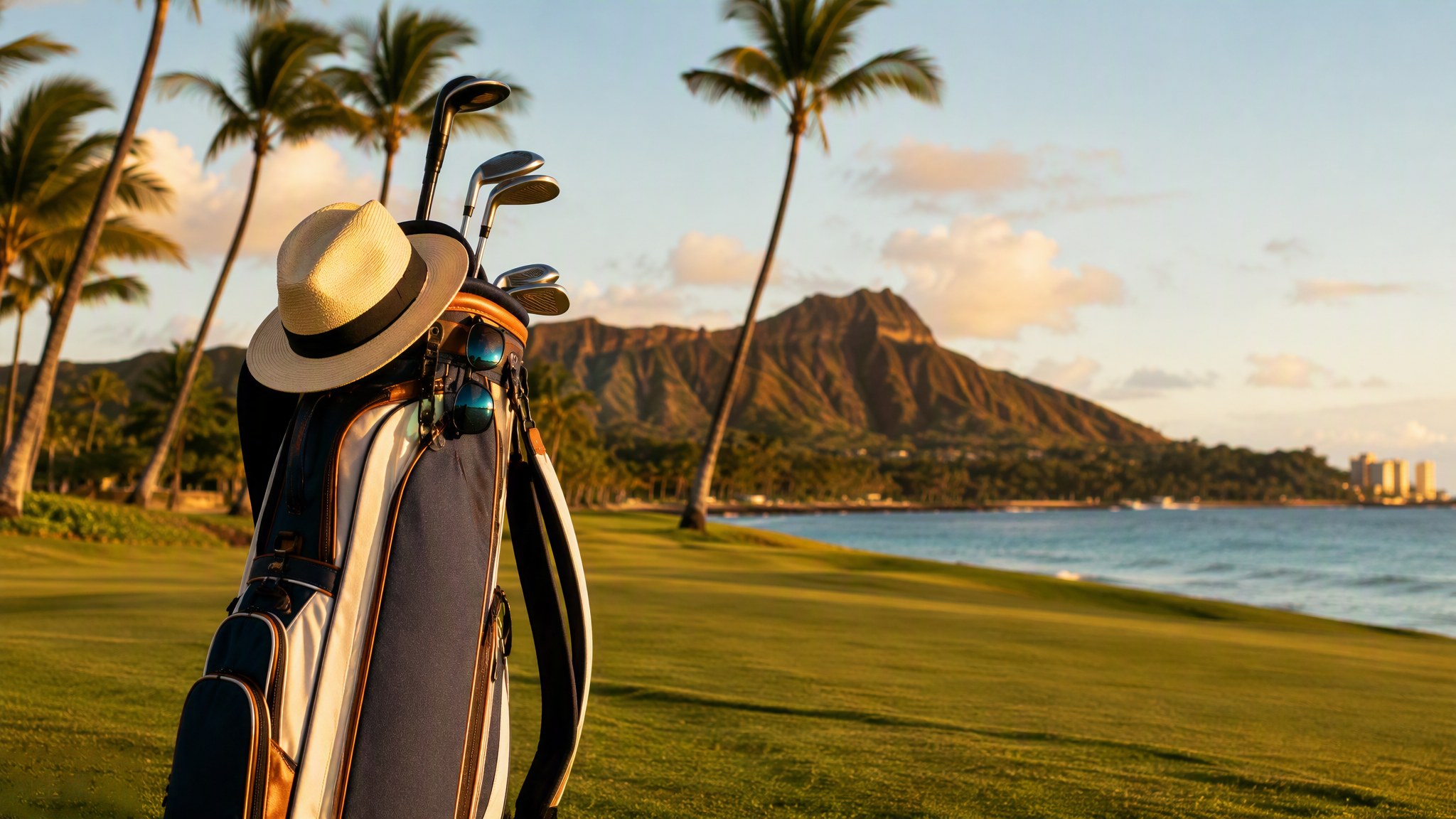
Non-negotiable. A wide-brim or bucket hat beats a visor for the midday sun, and polarized lenses cut the ocean glare you'll face on every coastal hole. Maui Jim is a Hawaii company for a reason.
7. Cooling Towel and Hydration
An evaporative cooling towel like the Frogg Toggs Chilly Pad draped around your neck makes walking nine holes in August genuinely pleasant. Every course has water stations or beverage carts — use them. Dehydration sneaks up fast in the islands.
8. A Collapsible Travel Umbrella
Doubles as sun shade and shower cover. The Repel Windproof Travel Umbrella handles trade-wind gusts better than most.
What to Rent (or Buy When You Land)
Golf Clubs: The Big Decision
This is the question every Hawaii-bound golfer asks. Here's the honest math:
Rent if:
- You're playing 3 or fewer rounds
- You're island-hopping (inter-island flights have baggage fees too)
- You're flying budget carriers with steep golf-bag fees ($35–$150 each way is common)
Most Hawaii resort courses rent current-model premium sets (TaylorMade, Callaway, PING) for roughly $50–$90 per round — check our course pages for rental availability at your specific course, and compare tee time deals on GolfNow where some listings bundle rentals.
Bring your own if:
- You're playing 4+ rounds (rentals exceed baggage fees quickly)
- You're a low handicapper who's particular about shafts and gapping
- You're staying on one island the whole trip
The third option — shipping: Services like Ship Sticks will door-to-door your clubs for roughly the cost of airline baggage fees, without the airport hassle. Worth it for trips of a week or more.
The fourth option — buying used: If you play Hawaii often, some golfers buy a quality pre-owned set from 2nd Swing and keep it with family or a storage unit on-island. Over a few trips it pays for itself.
Rangefinder
If you don't own one, don't buy one for this trip — Hawaii courses are well-marked and cart GPS is common at resorts. If you do own one, absolutely bring it: elevation changes and wind make yardage judgment tricky. A slope model like the Bushnell Tour V5 is ideal for mountainous layouts.
Push Carts
Nearly every Hawaii course includes a cart in the green fee (many resort courses require carts). Municipal courses like Ala Wai or Hilo Muni are flat and walkable if you prefer.
Hawaii-Specific Packing Tips
- Pack for wind, not just heat. Club selection changes by 1–2 clubs in the trades. Leave ego at home and take the extra club.
- Collared shirts only at resorts. Most resort and private courses enforce dress codes — collared shirt, no denim. Municipal courses are relaxed.
- Early tee times = dew. Morning rounds mean wet fairways and slow greens. Afternoon rounds mean wind. Pick your preference.
- Leave room in the bag. Macadamia nuts, Kona coffee, and a logo shirt from Kapalua are coming home with you.
- Kamaaina rates exist. If you're a Hawaii resident, bring your state ID or driver's license — many courses offer deep resident discounts. Check the rates section on each course listing.
Frequently Asked Questions
Is it cheaper to rent clubs or check a golf bag to Hawaii?
For 1–3 rounds, renting usually wins once you factor round-trip baggage fees ($70–$300 total). For 4+ rounds, bringing or shipping your own set typically costs less per round.
Do Hawaii golf courses have dress codes?
Resort and private courses generally require collared shirts and prohibit denim and metal spikes (virtually all Hawaii courses are spikeless-only to protect the turf). Municipal courses have no dress code beyond basic golf attire.
What kind of sunscreen is legal in Hawaii?
Hawaii law bans the sale of sunscreens containing oxybenzone and octinoxate. Mineral-based (zinc oxide or titanium dioxide) sunscreens are reef-safe and widely recommended.
Can I walk golf courses in Hawaii?
Yes at most municipal and public courses. Many resort courses require carts, partly due to distance between holes and terrain. Call ahead if walking matters to you — every course page on our site lists contact info.
What's the one thing golfers forget most?
Extra gloves and a second hat. One gets soaked or blows into a ravine — it's practically a Hawaii golf tradition.
Plan the Rest of Your Trip
Now that the bag is packed, find your courses. Browse all 80+ courses across the six islands — with green fees, amenities, and booking links — in our complete Hawaii course directory, or start with our Top 10 Golf Courses in Hawaii (2026 Rankings). If you're watching the budget, don't miss how to save money golfing in Hawaii.
Hawaii Golf Guide is reader-supported. When you buy through links on our site, we may earn an affiliate commission at no extra cost to you.
Never Miss a Post
Subscribe for the latest Hawaii golf guides and course reviews.
Plan Your Hawaii Golf Trip
Browse all 80+ golf courses across the Hawaiian Islands and find the perfect courses for your vacation.
Explore Courses